

Stalking, p.1
stalking, page 1
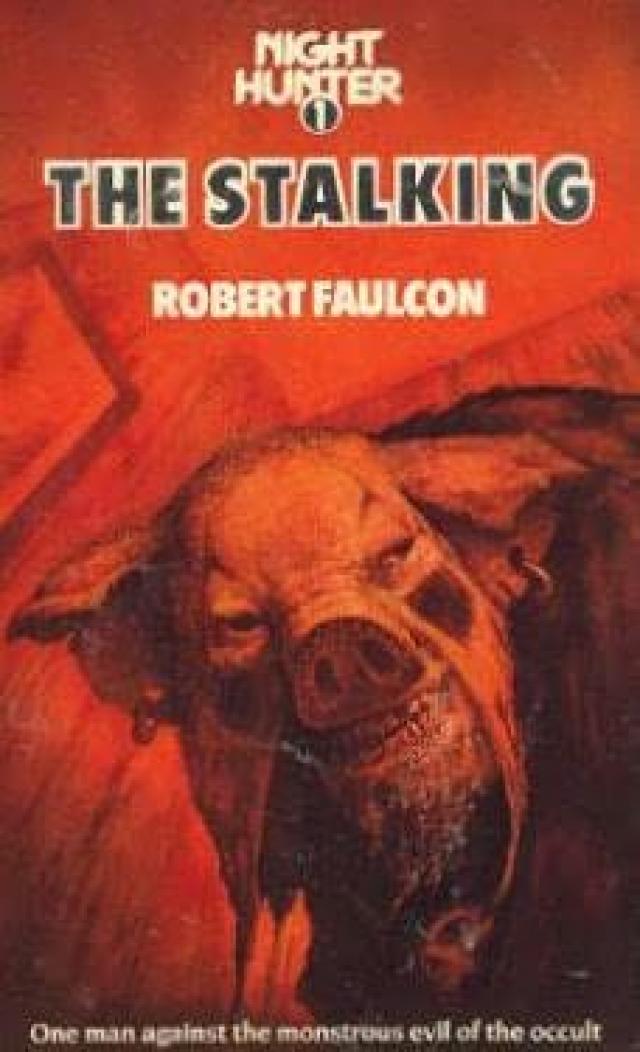


THE NIGHTHUNTER SERIES
COLLECTION I: THE STALKING The Stalking The Talisman
COLLECTION II: THE GHOST DANCE The Ghost Dance The Shrine
Separate volumes The Hexing The Labyrinth
Robert Holdstock writing as
ROBERT FAULCON
THE STALKING
ARROW BOOKS
PROLOGUE
* * *
It took just five seconds for the woman to walk briskly past the broad frontage of the restaurant. She held on to her shoulder bag with both hands, walking with a slight stoop. As she passed the window she turned and glanced quickly back along the road.
She was a woman pursued and could not hide the fact.
The five seconds, and that furtive hindwards glance, were all that the man who sat just inside the restaurant needed. He recognized her at once.
'Christ! That's Ellen!'
He became aware of the ripple of laughter in the half-full coffee shop, and glanced around in embarrassment. Five or six youthful faces regarded him in amusement.
Conscious of a healthy glow in his face, he reached for his coat and briefcase, then stepped quickly out into the chill spring air.
This area of London was quite unfamiliar to him; he knew Oxford Street, and Charing Cross Road, and the various side streets in the region of the University buildings near Senate House. But Islington was just a name to him, a reference on the Monopoly board. He didn't know much of London at all, living as he did in the quiet suburbs of Sussex. It was his work for the Ennean Institute of Paranormal Research that had brought him to this bustling East London thoroughfare. He had interviewed a man who claimed clairvoyant powers (and who patently possessed no powers at all, save those of persuasion) and had come to the steamy, unpleasant restaurant for coffee, a cheese sandwich, and a few moments of debate as to how he would spend the rest of the iilternoon.
And Ellen Bancroft, who had disappeared six months ago, had walked right past him, out of nowhere, out of memory . . .
And now out of sight.
It was market day, and the broad carriageway at the junction of Pentonville Road and Upper Street was a confusion of cars, buses and lorries, not to mention pedestrians surging like a mob towards the market stalls. He searched the crowds frantically for Ellen, following swiftly along the route she had taken.
By the time he had spotted her again, and was in hailing distance of her, he was quite breathless. He had to stop, doubling up for a moment and drawing breath deeply into his lungs before he could manage a cry of 'Ellen! Ellen Bancroft!'
The way she turned round was like a beast of prey cornered, eyes wide, face registering some awful fear. At fifty yards distance she couldn't have failed to recognize him, but she turned away and began to run.
'What the devil . . .?'
He picked up his case, trying to forget about the pain in his side, and sprinted up the road, managing to call her name again and cursing himself for his unfit condition.
She stopped abruptly, turned very slowly and let him catch up with her. They were opposite the pink facade of a cinema, next to the iron railings of a tiny park. He leaned against the fence and tried to smile as he caught his breath. He was in his forties, out of condition, and was now quite flushed. But he ceased to worry about his own discomfort; rather, he found himself shocked and distressed to observe this woman who had once been so close to him.
'What do you want, David? Are you following me?' Her words were cold, hostile.
He stood upright, shaking his head. Such anger when there had been such affection; such anger after so many months of disappearance.
When she had first come to England, from University in Boston, she had been a full-figured, dusky-skinned woman, with sparkling brown eyes and rich, black hair, hair that had framed a face as shapely and perfect as any he had seen in his life. To have seen Ellen Bancroft without a smile touching her lips was to have seen her (most likely) unconscious. She was cheerful, companionable and chatty, and she and David Marchant had been lovers; but she had settled with another man, and one not connected with the Iinnean Institute, and had had a child by him.
Now, just six months after the last time Marchant had seen her, she was hollow-faced and her eyes were rimmed with the dark lines of anxiety and fatigue; her hair was streaked with grey; her breath was stale; she stood before him, shaking, not with rage, nor with fear, but with something that seemed to consist of a little of both. A woman going rapidly and pathetically to seed.
'Ellen,' he said, as his heart calmed down and his breathing became easier, 'Ellen, where on earth have you been?'
'What do you want, David?'
'Just to talk. It's been six months or more . . . Everyone's upset by the way you just disappeared, Geoffrey Dean . . .'
She spat the name back at him, contemptuous, angry. He had forgotten the strained relationship between Ellen and her supervisor. 'We're just worried about you, Ellen. Elizabeth Smallwood, John Stanchell, all your old friends.'
'Enough!' she shouted at him, her face a mask of irritation. Her gaze shifted restlessly past him. She clutched her shoulder bag even tighter, trying to turn it away from Marchant.
'What's happened to you, Ellen? You look so ill . . .'
'Fuck off, David!' she said violently, and turned away, stopping only when he reached out and grabbed her arm.
Furiously she swung on him, stared at him hard, and said with careful, angry words, 'Go away, David. I beg you. For your sake, for my sake, just leave me alonel Forget you've seen me; forget me. If you keep following me. . .' a veiled threat, or an unspoken warning, he couldn't be sure, but he sensed behind the words a quality of desperation which told of her regret that she could not behave naturally with a man who had once been her lover.
He said, 'Let me help, Ellen. Let me help you . . .'
'You fool! I'm beyond help! You know what happened, to Michael, to Justin . . .'
'It was cruel. I know that. But you can't hide away for ever. Your friends are desperate to help, but you've -'
He stopped speaking. Her gaze had gone beyond him, her eyes widening with what he took to be shock. He immediately looked round: a busy street, people with shopping, young couples, children. There was a traffic jam at the lights; a faded yellow Datsun had broken down and three spikey-haired youths were helping to push it up onto the pavement, out of the way of the crush of cars and vans.
All this he took in at a glance. But when he stared back at Ellen she seemed shocked, then angry, and before he could say more than, 'What is it?' she had shouted, 'You bastard! You're one of them . . . you've led it here!'
She began to run, away from him, away from the traffic. Marchant followed her and in five long strides had caught her up and stopped her in her flight. 'Ellen, please!'
'Oh Christ!' she shrieked, staring beyond him. The look she gave him, then, was one of total contempt, a contempt which shifted into uncertainty, then resolve: her right hand slapped across his face, the nails turned in so that his skin was scratched with two inch-long lines. He clutched his cheek, felt the sticky warmth of blood, and was too stunned to do or say anything as Ellen raced away from him, hair flying, her arms awkwardly positioned as she struggled to run and keep hold of her bag.
Marchant turned again to see what had frightened her. He saw only ordinary people, doing ordinary things; the blood cooled on his cheek and he began to feel pain. He noticed that there was something pungent about the smell of that blood, as if she had smeared some chemical, or herb on his skin. He stared hard into the distance, wondering who had so terrified Ellen Bancroft.
She had left the main street, darting down a narrow passageway between the shops, and emerging into a wide square where four-storey houses rose steeply all around. Many of the flats, here, were empty, the buildings being run-down and often semi-derelict. The smell that hung in the air was of refuse, left for weeks without collection. It was an area of dereliction in sharp - and poignant! - contrast to the general belief that Islington was an 'in' part of the city, and had been attractively modernized; the nouveau chic had its areas of desolation.
Ellen was walking swiftly from the square. Marchant briskly pursued her, but half-way across he stopped, turned and stared at the empty passageway.
He could have sworn that someone had walked through behind him and called to him.
A woman came trotting down the steps from one of the houses, glanced at him, and scurried off towards the shops through the passage, unbothered by any person or persons unseen. Marchant was glad of that touch of normality. But something had disturbed him, either Ellen's strange behaviour, or something else . . .
As he walked from the square he felt his face go quite cold, his heart begin to race. The sensation of being followed was quite appalling.
Without really thinking of where he was headed, Marchant found himself in an area of garages, behind two blocks of flats. Across the courtyard an iron fire-escape rose up the side of a building close at hand and he could see Ellen's distraught figure rapidly climbing the stairs to an apartment some way above ground. She disappeared from sight.
He began to walk towards Ellen's apartment block, but to his surprise found his legs went weak, eventually refusing to move forward. He took a step back and tried again, but as he passed a certain point his head grew dizzy, his limbs went weak, and he was forced to retrace his steps to avoid fainting. His body was wet, soaking his shirt and trousers. He noticed that his hands were shaking.
Standing quite still, and staring up at the higher windows of the block, he called Ellen's name, and eventually thought he saw a curtain twitch on the third floor. 'Ellen. Please let me talk to you. Please!'
Behind him, someone took four quick steps towards him, and he turned in shock, half thinking that he was about to be attacked.
At the sound of the first scream an old lady came to the window of her flat and watched in shocked astonishment as the struggling body of a man was apparently blown high into the air, higher than the flats themselves. There was a persistent and agonized ululation of terror from the thrashing figure, which fell heavily back to the concreted roadway and began to crawl towards the fire-escape.
As if a sudden wind had gusted, and the man weighed no more than a leaf, he was blown across the courtyard through mid-air, body turning head-over-heels and smashing hard against a garage door. A moment later his clothes were shredded from his body, cast into the wind like tatters of coloured paper. The old lady choked on her own gorge as the naked man's head twisted completely round on its shoulders and the broken body ceased to struggle forever.
1
* * *
Later, he would think back to these cold, frantically busy days before Christmas and try to discern, among the chaos of experiments and travel and meetings, some clue as to what had happened, some hint as to the beginning of the tragedy that would soon sweep through his life.
At the age of thirty-five Daniel Brady was fully immortal. A tall, leanly-built man in the full flush of health, and with a secure and challenging research position in the Ministry of Defence at Hillingvale, he could no more have seriously contemplated his own mortality than he could have changed the flow of time. Death, if certainly a reality to him, was nevertheless a reality one step removed, something that happened to others. It was not a consideration that he applied to himself, or to his young wife, Alison, or to his two growing children. His concerns were for work, for the research project that was only giving very tentative results, and for his new house in Berkshire which was too big, too cold, and probably a very ill-considered buy; and his youngest child, six-year-old Marianna, was not settling in at school, and neither he nor Alison could understand why.
Worries about his family intruded upon the concentration necessary for him to conduct his research properly; concerns for his research likewise affected him at home: during the rainy autumn he had been broody, distant, distracted. He was well aware that results were essential in his line of work, and in particular in this place of work that had so readily accepted him from University, ten years before. The Ministry of Defence had small research installations scattered over the length and breadth of Britain. It was considered a considerable achievement to be invited to work in one of them. It was very common indeed for a man or woman to leave the Ministry's employ after two or three unsuccessful years.
Three days before Christmas Dan Brady had set up his study for one last attempt to get some results in the old year, prior to despairingly closing down the action until January 3rd. In the months to come, when he would have ample opportunity to contemplate these last happy, if frustrating days, he would see the first hint that at that time he had already been 'marked".
'Are we ready to go?'
Brady sat before two green-tinted screens, watching the solid-line traces upon one and the regular, wavy patterns on the other. In a small, enclosed cage a sullen looking female fat-tailed gerbil sat watching the blank walls of her environment. She couldn't see Brady, nor could she hear, nor smell, nor feel vibration through the wall of her prison. Brady's sole contact with her was through the cerebellar trace on the screen; the animal's hind-brain was active, and actively registering.
The young man who worked as Brady's research assistant made some final adjustments to the various pieces of equipment, then sat down at his own station and called, 'Ready.' He was thin and willowy, his eyes framed by huge, silver rimmed spectacles. He wore the white coat of a lab technician, whereas Brady was dressed informally, casually (his department supervisor said scruffily) in a voluminous roll neck, and grey cord slacks. Brady hated formality, and the formal attire of the laboratory.
He leaned forward and peered beyond a glass screen into a strange landscape . . .
It was night and the desert was cold. There was no moon, but an eerie light picked out the shapes of boulders, stubby cactus, and the solitary, upright shape of an animal, feeding nervously on a locust. The creature was small and rat-like, its feet abnormally long, and it balanced precariously in the danger-filled darkness, ready to flee at the first hint of attack. Pachyuromys duprasi was a native of deserts in East Africa; a nocturnal predator of locusts, spiders and other night-feeding creatures it was, itself, the natural prey of the sand cat.
Into this tiny desert, bordered not by the lusher vegetation of a river terrace, or by high, snow-capped mountains, but rather by perspex walls darkened to allow the illusion of night, into this miniature world the first danger came.
The sand cat betrayed its stealthy approach by the faintest of drumming on the reverberant sand. The gerbil straightened, ceased chewing, then peered to the right and the left through wide, shining eyes. The cat leapt towards it in an instant, but the gerbil was faster: it bounded across the dry, chill landscape until it fetched up against the invisible wall across its territory.
The pursuit was not continued; the cat was illusory, generated by the research assistant from across the environment.
But in that single instant of escape something happened fifty yards distant, where Brady sat watching the screens, and the imprisoned female animal. First, on the broader of the two screens, which showed four single, unbroken traces, a tiny, almost fleeting peak of activity had occurred. On the smaller screen, which showed the cerebellar activity of the female gerbil, three powerful, sustained peaks registered a dramatic change in the unconscious awareness of the tiny animal.
Out of sight of her mate, unaware of the danger, the female's own hindbrain had registered the input of a warning signal; not by sound, nor by sight, nor by vibration; an extra-sensory signal had been relayed from brain to brain, and then to machinery; a warning signal that had been observed!
Brady sat back in his chair and allowed himself the luxury of a thin smile, a token gesture of self-congratula-tion. 'What did we get?' called the assistant, and Brady said, 'A hint . . . just a hint. The female registered the warning very powerfully, but our own detectors spotted something too. Just a hint . . .'
'Stronger than Trial 17?'
'Maybe not. But a damn sight stronger than nothing at all!'
The wiry young man beamed his pleasure. They'd got two results, then, out of forty trials. They'd repeated their result, and surely now it was just a question of refining the equipment until it was sensitive enough to clearly pick up the electro-magnetic output of the frightened animal.
'And that,' said Brady, beginning to rise from his chair, 'is that until the New Year. Close down for Christmas. . .'
He had been about to say more, but he stopped, feeling suddenly cold, suddenly chilled. He straightened and looked around, wondering idly if cool air from the desert environment was leaking into the laboratory. A light flickered. The research assistant frowned, looked uneasily around. For some reason Brady stared at the oscilloscope screens, at the single lines that showed the machine's own mechanical unresponsiveness, and at the fluctuating output from the brain of the female gerbil.
And quite suddenly the signals went haywire.
'Good God, come and look at this!'
Brady leaned forward on the console, watching the trace from the gerbil peak and race, the animal cowering in a corner of its box, staring vaguely upwards and outwards, the leads from the skull probes tangled around its tiny body.
'Something's scared the hell out of it. . .and the other!'
In the desert the gerbil was racing in energetic circles; the mechanical trace, for all its insensitivity, was registering an output of electro-magnetic energy of such strength that the signal was too large for the screen.
In the eerie silence Brady stared first at the machinery, then at the animals. Finally, the signals on the smaller screen became single, straight lines; the animals had died.






