Against all odds, p.1
Against all Odds, page 1


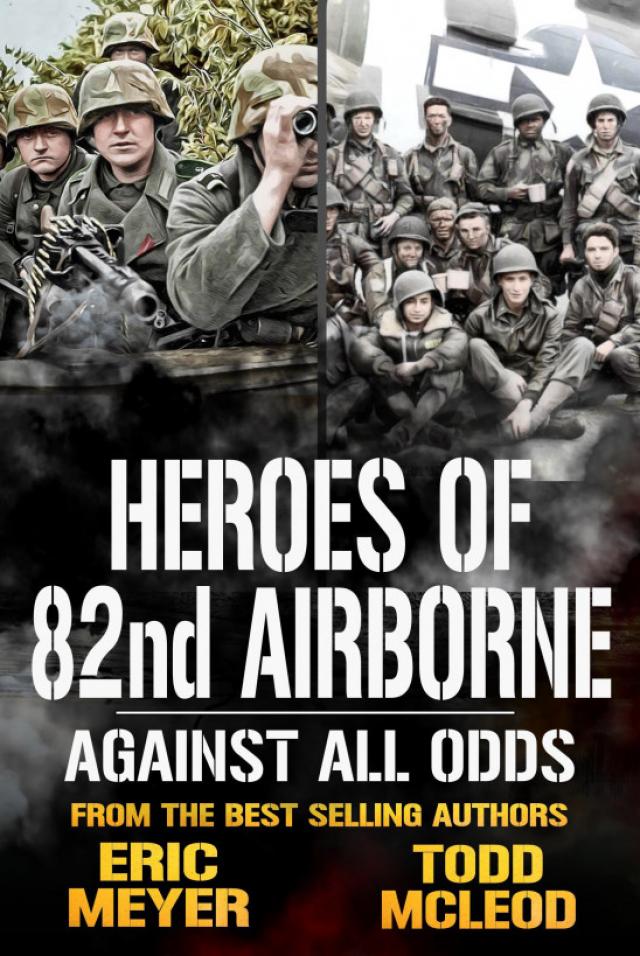
Against All Odds
By Todd McLeod & Eric Meyer
BOOK 2 of the Heroes of the 82nd Airborne series
Short Fiction
Copyright 2020 by Todd McLeod & Eric Meyer
Published by Swordworks Books
All rights reserved. Without limiting the rights under copyright reserved above, no part of this publication may be reproduced, stored in or introduced into a retrieval system, or transmitted, in any form, or by any means (electronic, mechanical, photocopying, recording, or otherwise) without the prior written permission of both the copyright owner and the above publisher of this book.
This is a work of fiction. Names, characters, places, brands, media, and incidents are either the product of the author’s imagination or are used fictitiously. The author acknowledges the trademarked status and trademark owners of various products referenced in this work of fiction, which have been used without permission. The publication/use of these trademarks is not authorized, associated with, or sponsored by the trademark owners.
MY NEWSLETTER
If you’d like to receive my latest news, special offers, and free books then please sign up for my newsletter. It’s a great way of keeping up to date with my latest projects, as well as getting samples and free books throughout the year. Click on the link and join up today. You can also visit my official website and Facebook page, links below:
My official newsletter: subscribepage.com/EricMeyer
My official website: ericmeyer.co.uk
My Facebook Page: facebook.com/ericmeyerfiction/
Chapter One
“I can’t see a damn thing. It’s these damned hedges.”
PFC Harry Byrd, First Platoon, B Company, glanced at his buddy, PFC Ray Cassidy. Like him, he wore the ‘AA’ embroidered flashes of the American Airborne Division, but that was their sole similarity. They were as different as chalk from cheese. Ray was an outdoorsman, where he was in his element. Wiry and tough, he was never happier than when he was in the woods, his piercing dark eyes searching for game. Frequently he’d track an animal for hours; carrying home game for his mother’s larder, and enjoying evenings in the local bar, swapping jokes with his friends, his girl Patsy Roberts, hanging on his arm giving him adoring glances. Okay, he knew he was Mr. Average, but it sure felt good.
Before he joined up, Harry was a city boy, more at home in the snooker parlors, and never happier than when watching a drive-in movie from the back seat of his Chevy convertible with his arm around his latest squeeze. Unlike Ray, whose lifestyle lent his skin the color of buckskin, Harry was pale, and he looked flabby for an Airborne trooper. Although underneath the flab lay solid muscle. At nearly six feet, he was had blonde hair, a throwback to his Scandinavian ancestors, and piercing blue eyes always ready to smile at a joke.
“I heard someone say they call them ‘bocage.’ French farmers plant them to mark out fields.”
He grunted. “The Jerries may as well have paid them to grow them so high.”
They were marching along a narrow line with the towering hedgerows on either side. The new platoon leader was Lieutenant Frank Horton, a newly minted West Point graduate, boot-chinned, straight backed and determined to make his way in the Airborne. He probably would if he lived long enough, and that depended on him losing the theory that an officer should lead from the front. There were times when it was the right thing to do, and times when it wasn’t. He had yet to work out the difference. Horton was the replacement for Lieutenant Frank Bond who was badly wounded several days ago.
He marched out in front, and they watched Sergeant John Logan pick up the pace to draw alongside the eager officer to give him a timely piece of advice. Cassidy didn’t need to be a mind reader to understand what he was saying. ‘Your predecessor ended up badly wounded, so take it easy, and try and live a bit longer.’
Horton appeared to ignore him. Most men didn’t ignore Sergeant Logan. The rumor was he’d been a nightclub doorman in civilian life, and he looked it. Tough and broad shouldered with a broken nose on his scarred face. Despite his forbidding appearance, Logan was a decent enough guy, and every man in the platoon knew they could look to him for help when they needed it.
The Sarge fell back, and Horton continued leading from the front. Just like they used to in the old days. Although in the old days they didn’t have machine guns and tanks. And they didn’t have bocage.
“That guy’s gonna get himself killed,” Harry murmured, “Didn’t anybody tell him there’re Germans around here.”
Before he could reply, the Sarge came alongside them. “You two men catch up with him. He’s walking into trouble.”
Ray Cassidy had been thinking that exact same thing. “Roger that, Sarge. Harry, let’s go.”
They jogged forward of the platoon until they were right behind Lieutenant Horton. He gave them an irritated glance. “What do you men want?”
“Just keeping an eye out for the enemy, Lt. Three pairs of eyes are better than one.”
He nodded. “So far there’s no sign of the Jerries. I reckon they must’ve retreated into Saint-Lo. We should…”
He stopped as a swarm of aircraft roared overhead. Dive bombers, descending fast and heading for the city of Saint-Lo. Seconds later they reached their target and unloaded the ordnance on the city. More punishment for the city bombed out of all recognition since high-level bombing had begun on D-Day, June 6.
Horton gestured toward the plumes of smoke and flames reaching up to almost touch the clouds. “There they go. Any Jerry with any sense can see what’s happening there, and they’re long gone.” He turned back to regard the platoon straggling behind and shouted, “Sergeant Logan, close the men up. We’re less than three miles from the city.”
Logan acknowledged the order, and they started to close the gap. The shit hit them a second later. The Germans weren’t enduring a further bombardment inside the city of Saint-Lo. They had retreated east, running from the Allied advance. They were tucked behind the bocage where they’d established a strong point to block the advance of anyone foolish enough to believe the invasion of Normandy was almost over.
Ray Cassidy saw the machine gun bullets kick up spurts of dirt from the unsurfaced roadway, and the gunner was good.
“MG42, get down!” he shouted, as he gave the Lieutenant a fierce shove that knocked him to the ground. He pushed him into the cover of the thick hedgerow until he was out of sight of the machine gun.
Harry was shooting in the direction of the machine gun even though he couldn’t see it, and behind them Sergeant Logan had got the men into what cover they could find. Two men were frantically cutting a gap in the thick hedgerow to get through and hit the Germans from the flank, but it was slow going. He squinted to search for a way through, and he found it fifty yards ahead, a tangled mess of branches where a vehicle had miscalculated and plowed into the thick hedge. Probably one of the many Eastern Europeans the Germans had recruited, and as drivers went they made the Italians look skilled.
He didn’t give a damn who’d collided with the hedge. He needed that gap. Slowly, he snaked forward, keeping flat on the hard dirt, and the machine gun found him. The gunner aimed a stream of bullets that whistled overhead. He felt a round pluck at his shoulder and another bounced off his steel helmet. And then Harry fired back, a long stream of bullets from his Garand. Further back, the Sarge realized what he was trying to do. He opened up with the Thompson machine gun he’d carried since they’d fought their way out of a previous ambush, and he told the armorer he needed something that fired more bullets.
The rest of the platoon opened fire, and even Lieutenant Horton managed to crawl back out from the hedge and join in with the shooting. The German wasn’t fooled and kept his fire directed at Cassidy until a soldier from Third Platoon, who’d been walking behind them, aimed and fired a bazooka at the German position. It tore into the bocage and exploded in a cloud of smoke and jets of flame. Ray had no way of knowing if he’d destroyed the machine gunner, but smoke and dust had clouded the area. He took a chance, scrambled to his feet, and ran. A lung bursting run toward the damaged hedgerow, he reached it and dived inside a second before the smoke cleared and the machine gun resumed firing.
He crawled through the gap, and it penetrated the bocage halfway. He had to force his way through the rest of it, putting aside the tangles of wiry branches, thorns ripping into his uniform, and tearing at his skin, but he got through far enough to see what lay on the other side. The Germans had chosen well, a slit trench protected by rows of boulders they’d taken from some unlucky farmer’s wall. Positioned close to the hedgerow, where they’d cut a narrow firing slot to cover the lane. He paused.
Do they know I’m here? If they saw me dive into that damaged hedgerow, they’ll be waiting for me.
They were around eighty yards away, and there was no cover. No way to reach them, save by sprinting across open ground. If they saw him, he was dead, no question. The gunfire increased in volume from outside in the lane, and the machine gun chatted again, spurting bullets at his buddies desperately trying to find cover. There was little cover, and men would be taking hits. He had to gamble they hadn’t seen him, gamble they were so focused on the Americans trapped in the lane, he could get to them before they knew he was coming.
He paused for a moment, less than a second. This was the ultimate gamble, and the stakes were high. His life. Too bad, and he mentally shrugged. He was a paratrooper, 82nd Airborne, and the Division was building a reputation. Reputation forged by men like him taking chances like this. Withou t another thought he was up on his feet, running like he’d never run before. Sucking in breath, feeding oxygen to his muscles, his legs pounding like pistons, and all he could see was that pile of stones in front of the slit trench. The ominous black muzzle of the MG42 poking out, spitting bullets through the gap in the hedgerow, and he was seeing the men he’d fought with, eaten with, joked with, and sometimes cursed with, dying. The fury built inside him like stoking a furnace, adrenaline poured through his bloodstream, and he didn’t feel his boots touching the ground.
He was floating, almost like he’d entered a nightmare and nothing around him was real. There was him, and there was the machine gun. The men inside the slit trench weren’t real. There was just him and the machine gun. He didn’t notice he was almost there until a head popped up wearing the iconic German helmet and dropped back down. A voice shouted something unintelligible, and the next moment two soldiers appeared and pointed their Mauser rifles at him. A shot cracked out, followed by a second.
He didn’t pause, didn’t swerve away, and didn’t dive for cover. He just ran up to the trench and aimed his rifle at the nearest soldier. Squeezed the trigger, and the man went down. The second soldier opened his mouth to shout something. Maybe a warning, maybe in fear at the sudden appearance of the paratrooper, but no sound emerged. Ray put a bullet into the gaping mouth and ran to the edge of the slit trench. The gunner was still there, still alive, crouched behind the machine gun, and he was dragging out a stick grenade he’d tucked into his belt.
He pulled the ring to arm the detonator and threw his arm back to toss the weapon outside and kill approaching enemy soldiers before they got to him. He threw, and the wooden handled missile, nicknamed the ‘potato masher,’ arced toward him. In desperation, Ray flipped up his Garand, held it by the barrel, and batted the grenade downward with the wooden butt. He’d played baseball in High School, but never had he scored a home run like this one. The hardwood butt collided with the missile and knocked it back down into the trench.
The gunner had a scant second to regard the grenade coming back at him before Ray threw himself to one side, and the explosion threw clumps of earth and chips of dust and stone over him. He climbed back to his feet and looked into the trench. The gunner was dead, his body torn apart by his own grenade, and a quick check confirmed the first two men he’d shot were also dead.
“Cassidy, what’s happening over there?”
Lieutenant Horton had found the gap in the bocage, scrambled through, and he was fifty yards away, racing toward him clutching his M3 Grease Gun.
“They’re all dead, Lt.”
“You’re certain?”
He fought back a smile. “As the coffin lid closing.”
He nodded. “That’s good work.” He began brushing the dust and dirt from his uniform. From the start they’d noticed Horton was a fastidious dresser, and where Cassidy had thrown him to the ground and dragged him through the dirt into cover he was badly in need of a laundry, “Next time, give me a warning, and I’ll manage on my own.”
“Sure thing, Lt.”
As I recall I did shout a warning, but what the hell. We’re alive, that’s what counts.
The rest of the platoon fought their way through the hedgerow and caught up with them. Horton began searching for a way to rejoin the lane, until the Sarge pointed out they may be better staying away from that particular section of lane.
“Sir, there could be more ambushes, and they’re sure to use the bocage as cover. If we stay on the side, we can maybe get the drop on them.”
“Uh, yeah, I was thinking the same thing. First Platoon, move out.”
He went to the head of the column, but Logan halted him. “Normal procedure is to put a man on point, Lt. Warn us of any trouble.”
“Sure. Cassidy, take the point.”
Ray walked on, his eyes raking the ground ahead, looking for indications of more enemy soldiers. They were there, he was sure it, it was just a question of finding them. They may have been Nazis, at least most of them, but they were good soldiers. Well led, and they weren’t short on knowledge of battlefield tactics. He was aware of his own shortcomings. They’d parachuted into Normandy less than ten days before and that was all the battle experience they’d had. Ten days. As opposed to the Krauts, who fought their way across Western Europe and through Eastern Europe into the Soviet Union. Along the way they’d earn a lot of experience, and he was wary.
More aircraft flew overhead, higher this time, heavy bombers, and further explosions continued the destruction of the city of Saint-Lo. The noise was shattering, even from two miles away, so loud it covered the sound of approaching engines. It took him several seconds after the last bomb fell to interpret what he was hearing, and he whirled around.
“Tanks! German armor approaching.”
“How many?” Horton shouted back.
“I can’t tell. They’re out of sight. Lt, who gives a shit? One is too many, and there could be a dozen.”
The Sarge reacted fast. “Everyone, scatter!”
“Run!” Horton shouted.
“Belay that, just get your asses under cover.” He was already running, dragging the Lieutenant along with him, “We can’t outrun tanks. Our only chance is to stay out of sight.”
The only cover they found were the huge hedgerows, and men were still pushing inside when the first armored behemoth appeared. Ray was already deep in the hedge. It was a Panzer Mk IV, leading four more Panzers, each armed with a 75mm main gun. The commanders were seated in the turrets with the hatches opened. Clutching 7.92mm machine guns, swiveling the barrels from side to side as they stared into the hedgerow, looking for targets. Ray suddenly realized when they came abreast of his hiding place they couldn’t fail to spot him.
Chapter Two
What saved him were the aircraft. Thanks to Ultra, the method of top-secret radio interception and decryption, the headquarters could monitor enemy movements, especially of armor, and dispatch fighters and bombers to hit the targets.
Like now, and a flight of eight British Typhoon ground attack aircraft swooped down, firing scores of rockets into the unsuspecting armor. The Germans never stood a chance, and all First Platoon could do was cower behind whatever cover they could find, singed by the flames of exploding and burning tanks. Staying alive until it was all over. The aircraft flew away, and they emerged into the open.
“I don’t believe it,” Harry breathed, “Five Jerry tanks reduced to so much scrap metal in less than a couple of minutes.”
Someone muttered, “Praise the Lord.”
Another man had a different take on their salvation. “Praise the British RAF.”
Horton watched the blaze with the rest of them, awed by the ferocity of the attack. Some men heard another engine approaching along the lane, but this time a smaller vehicle. Cassidy recognized the sound made by a Willys Jeep. “It’s okay. It’s one of ours.”
They pushed back through the hedgerow in time to greet the driver, Colonel Henry Gates, the grizzled, leather-skinned regimental commander. He was alone, and he dragged on the parking brake, and leapt out of the vehicle while it was still moving, regarding the smoke on the other side of the hedge. He was that kind of guy. A firebrand.
“What happened here?”
Horton rushed up and saluted. “Ambush, Colonel, a machine gun, and then Panzers. We were lucky, a bunch of Typhoons got them all with rockets.”
“That’s good to know. Where’re you headed?”
“29th Infantry is somewhere behind. They’re heading toward Saint-Lo to start the attack on the city. We’re scouting ahead for ambushes.”
“Not any more you’re not. You have new orders, Lieutenant. You’ll be first in.”
“Excuse me, Sir? First in to where?”
“To Saint-Lo. We have a problem. The French resistance informed us the Germans have prepared strong defenses, artillery, machine guns, and mortars to stop us instead on the outskirts. The 29th is about to run into a storm, and those guns will tear them to pieces before they get close.”